
*Only required for non-members and guests

Congregant and spiritual educator Laura Hegfield leads a half-hour meditation on the first morning of Rosh Hashana and on Yom Kippur. The focus this year is returning to love. Laura shares a melody and a grounding teaching, and leads us through a time for quiet meditation. The group meets on Zoom and is available to watch in the temple library as well.
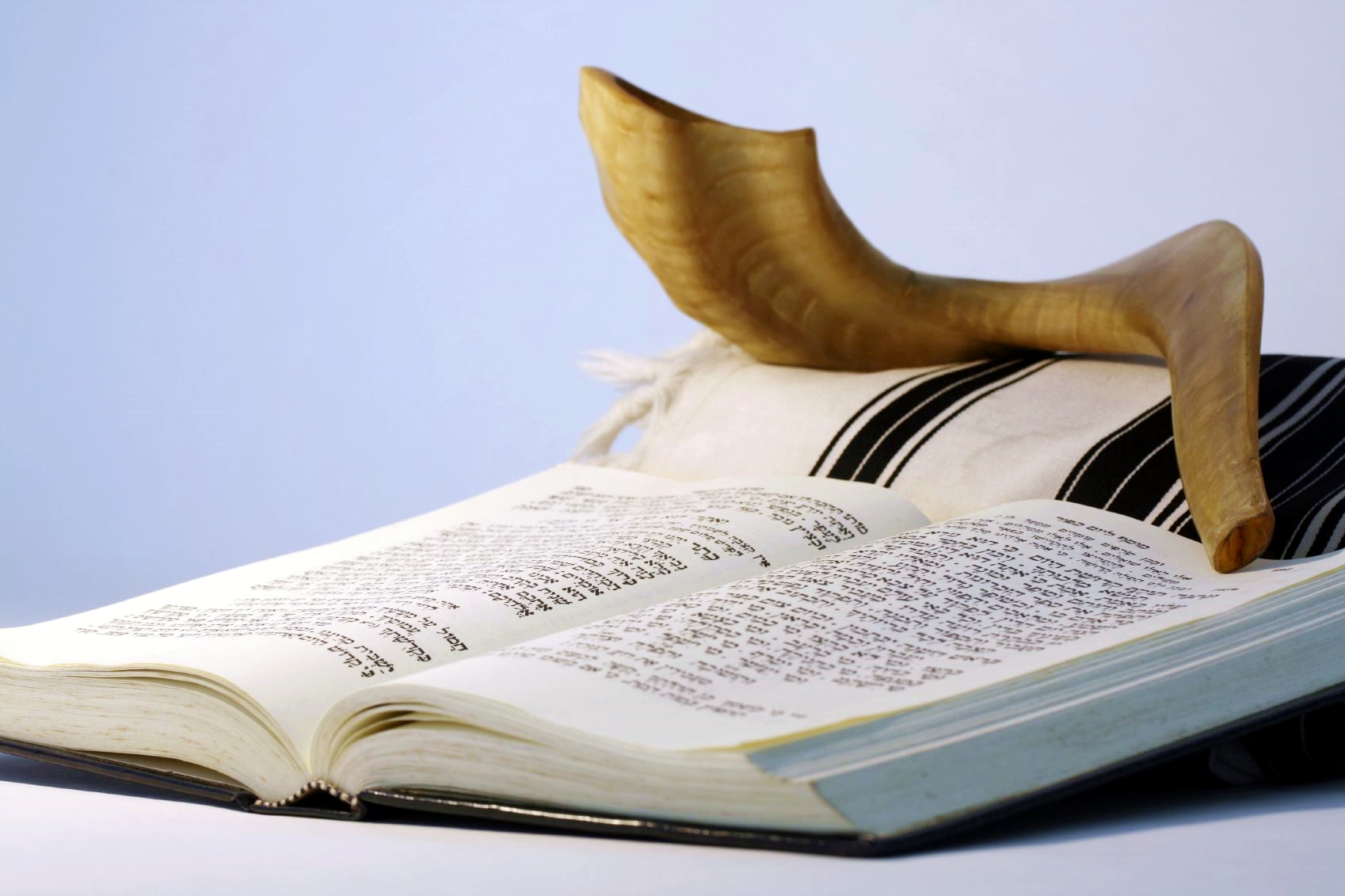
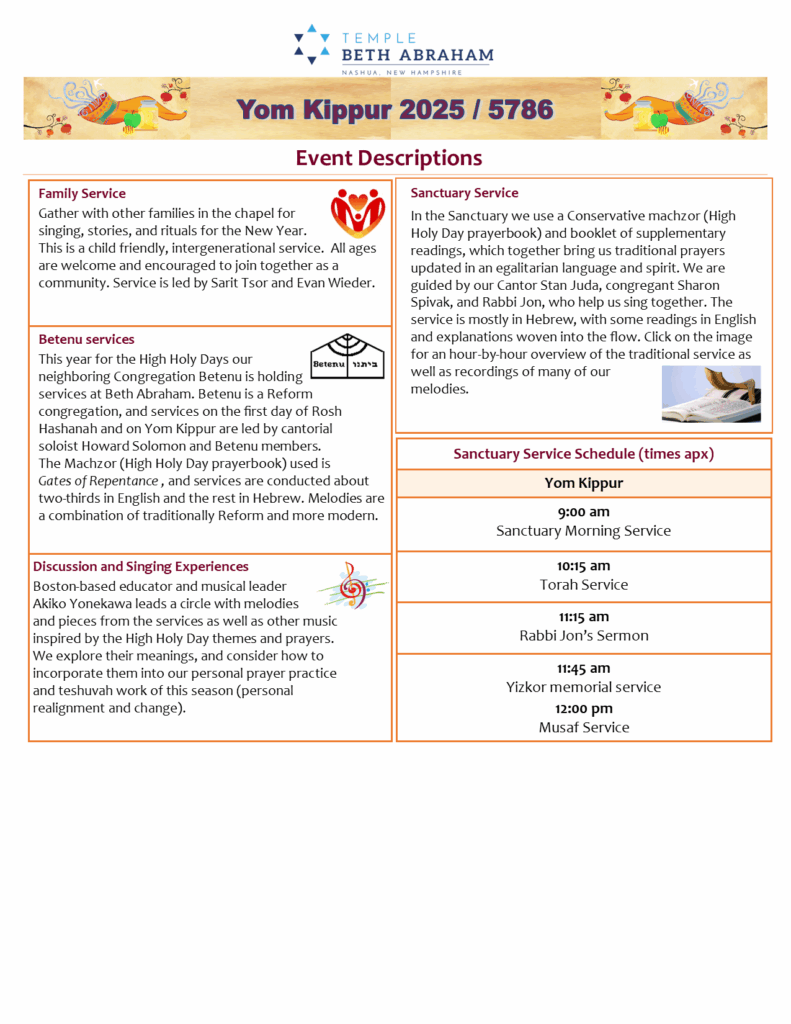
In the Sanctuary we use a Conservative machzor (High Holy Day prayerbook) and booklet of supplementary readings, which together bring us traditional prayers updated in an egalitarian language and spirit. We are guided by our Cantor Stan Juda, congregant Sharon Spivak, and Rabbi Jon, who help us sing together. The service is mostly in Hebrew, with some readings in English and explanations woven into the flow. Click on the image for an hour-by-hour overview of the traditional service as well as recordings of many of our melodies.
Gather with other families in the chapel for singing, stories, and rituals for the New Year. This is a child friendly, intergenerational service. All ages are welcome and encouraged to join together as a community. Service is led by Sarit Tsor and Evan Wieder.
This year for the High Holy Days our neighboring Congregation Betenu is holding services at Beth Abraham. Betenu is a Reform congregation, and services on the first day of Rosh Hashanah and on Yom Kippur are led by cantorial soloist Howard Solomon and Betenu members. The Machzor (High Holy Day prayerbook) used is Gates of Repentance , and services are conducted about two-thirds in English and the rest in Hebrew. Melodies are a combination of traditionally Reform and more modern.
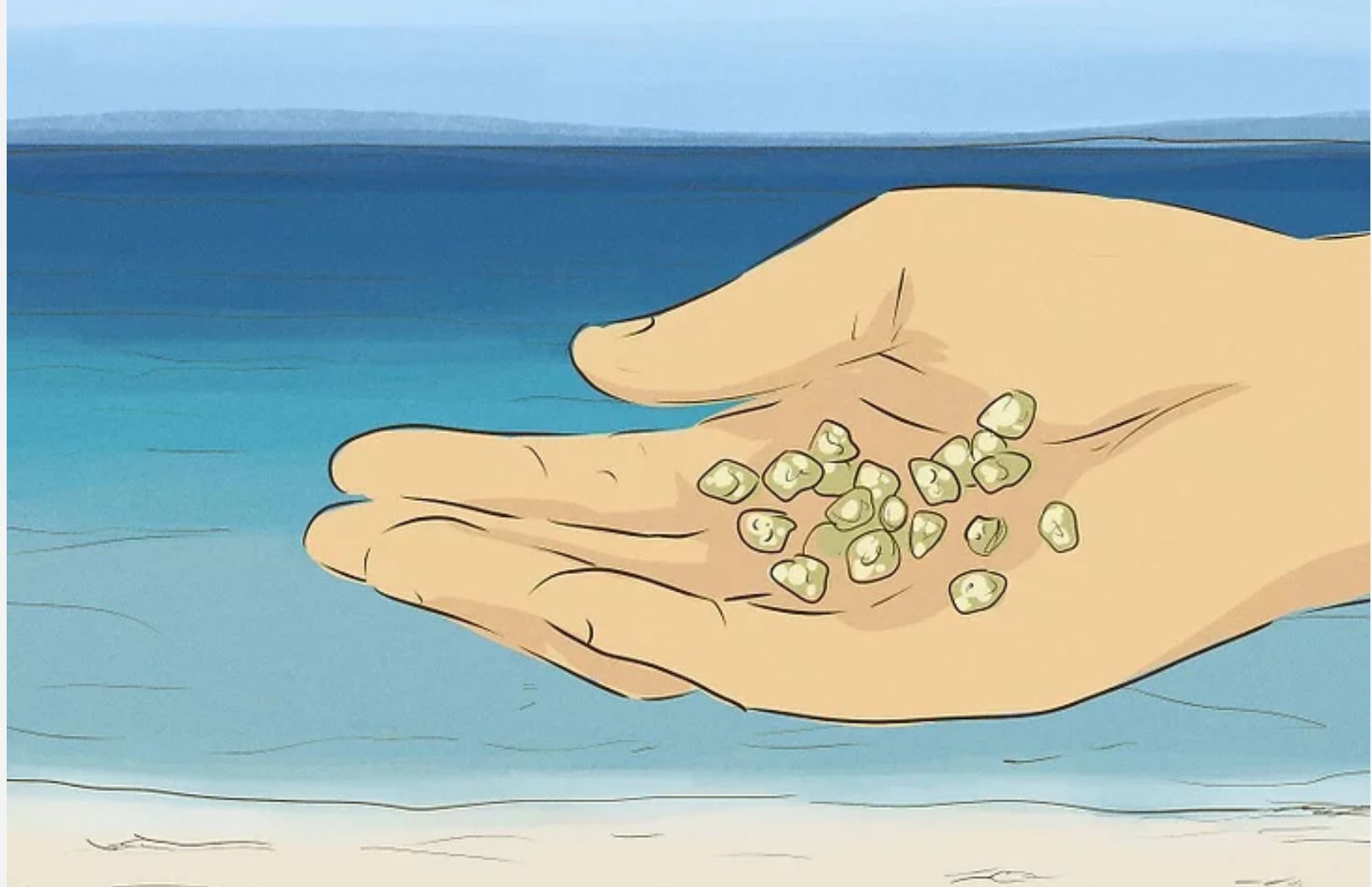
On the first day of Rosh Hashanah after services end, we gather by the Nashua River downtown for a ceremonial cleansing of our souls by casting seeds into the water and hearing the Shofar’s sound. Location: Downtown Nashua (Front St. Boat Launch)

(Rosh Hashanah Day 1 @ 9:45 am) Hearing the shofar blast is the signature ritual of Rosh Hashanah, but what does it mean? What is the shofar experience asking of us and how are we to respond? In this discussion, we will dive into the emotional and spiritual explanations by ancient and modern Jewish teachers to explore what the shofar might mean to us. Led by Aki Yonekawa, Boston-based Jewish educator who is joining us for second year..
(Rosh Hashanah Day 1 and Yom Kippur @ 12:00 pm) Join us for a soulful group singing experience. All voices are welcome! We will learn short songs that can be picked up easily and sung repeatedly as the group sinks deep into the melody. Songs come from traditional and modern sources, reflecting the themes of the High Holy Days. No prior singing experience required. Led by Aki Yonekawa, Boston-based Jewish educator who is joining us for second year.

(Rosh Hashanah Day 2 @ 9:45 am) The cycle of the Jewish calendar invites us to spend a significant amount of time looking back on the year and taking account of the ways in which our actions have fallen short of our greatest potential. In this discussion-based session, we will explore how this cycle encourages us to cultivate a growth mindset in our lives - to help us shape our own iterative process of living and learning. If you think you qualify as a young adult, then this session is for you! Led by Aki Yonekawa, Boston-based Jewish educator who is joining us for second year.

(Rosh Hashanah Day 2 @ 12:00 pm) Liturgy is made up of words, music, and a little bit of choreography. Learning how these parts fit together and practicing beforehand can help us to get the most out of the experience. On Yom Kippur, the liturgy will have us engage in an important part of the process of teshuvah: confession. Regardless of one’s own account of personal misdeeds, the congregation stands together to read a litany of wrongs done with intent or without, with many people beating their chests with each confession. In this session, we will take a look at the text, melody, and theater of this liturgical confession as a rehearsal of sorts for our own Yom Kippur prayer practice. Led by Aki Yonekawa, Boston-based Jewish educator who is joining us for second year.
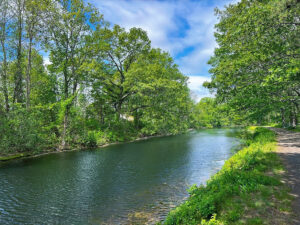
Join Nature Guide Kenny Wadness for a mindful walk and Tashlich at Mine Falls Park. We will walk, meditate and reflect using the power of “forest bathing” to refresh and renew our spirit for the new Jewish year.

An explanation of terms and ideas related to the High Holy Days
Our guide for the High Day Season, Rosh Hashanah Torah Readings, and the Machzor (High Holy Day Prayerbook)
Click on the icon to view and download detailed instructions for holding a Tashlich ceremony for yourself and others. Although traditionally we use bread crumbs, you may choose to use birdseed for safer environmental impact.
Frequently Asked Questions About In-Person Services
Beth Abraham has a good-sized parking lot, and if you come within the first 30-60 minutes of services you are likely to get a spot there. You are welcome to park along the side streets in the neighborhood, such as Raymond, Chester, Berkeley, and Wood Streets. Please make sure not to block anyone’s driveway and to respect a distance of 25 feet from any intersection, according to Nashua city regulations.
The Temple doors are locked even during services. We have one entry point, through the main front entrance. Members are given access cards or fobs – please bring yours and use it to enter! If you are not a member or if you don’t have your access card/fob, there is a video doorbell and you’ll be asked for your name.
Anywhere! Beth Abraham has no assigned or pre-arranged seating.
We always save some seats that are easy to get to, by aisles and near the main doors into the Sanctuary. The ushers will be happy to help you. We have wheelchairs available.
Children are welcome in all of our services and activities, all the time through the holy days! In addition, we have family services and activities scheduled – consult the overall schedule.
Absolutely! Children of any age can experience services and be fascinated by many dimensions – the big room, the presence of so many Jews, the sounds of singing, the intangible atmosphere of introspection. Being together with your child or children can be profound for you too.
If you have a child who is making noise or moving around, try sitting toward the back, in case you need to go out and take a break with your child in the Gallery or outside. But a little noise from young people contributes a good energy! Do make sure to supervise your children at all times, whether they are in the service or in the open spaces. During the rabbi’s sermon or Yizkor memorial prayers, we do have an atmosphere of quiet.
Traditionally, there is no writing on Shabbat and holy days. One suggestion is stickers! Manipulative toys that do not make noise are also great.
You can! This might help especially if you want to stay for more than one part of the service or more than one gathering during the day. We will also have snacks available.
We are a kosher facility, so you can bring:
Foods baked in your home may not be brought in (even the rabbi’s family abides by this rule).
On Yom Kippur, you can bring snacks for children too young to fast, and if you need a little food or water for medical reasons, you should bring that too – just step to a little less crowded area when you eat. If you have a question, or if you have special dietary needs that are hard to meet this way, ask Rabbi Jon ahead of time and we will work out something together to meet your needs.
We ask those who identify as male to wear a kippah on the head, whether you are Jewish or not. We encourage but do not require those who identify differently to do so as well. If you are a Jewish adult and identify as male we ask that you wear a tallit, and we encourage any Jewish adult to wear a tallit. We have both tallitot and kippot available for people to wear.
We observe the holy days by the traditional rules for Shabbat and festivals, which help us create an atmosphere of mutual connection, joy, and reflection. Cellphones, cameras, and electronic devices are not used in the synagogue. If your work or a responsibility for someone else requires you to be reachable, please set your device to vibrate, turn it off as soon as you perceive a call, and then walk outside the building or to an isolated corner somewhere to pick up a message or return a call.
Yes, you certainly can come and go during services! There are certain times when it is not appropriate to leave – usually when the congregation is standing. You are welcome to be in the Gallery, which is our big open foyer. Many people like to schmooze while services are going on.
We ask that you be mindful of the fact that even quiet conversations carry toward the prayer spaces, even when the doors are closed. So keep conversations quiet inside the building, and if you are talking find a place that is far from the Sanctuary.
Yes! In fact you will find a cart in the Gallery with a lot of Jewish books curated by Rabbi Jon to read instead of or in addition to the prayerbook. And absolutely bring any book, magazine, or printed material that you think will help you focus, as long as it is printed and not electronic and as long as any images are appropriate for those around you.
If you feel sick with symptoms associated with Covid-19 or another infection illness, you should stay home and get any medical attention you need, and let us know if there is some way we can help you with needs during your illness. If you have been closely exposed to someone who is sick with such an illness within the previous few days, you should also stay home. We have many opportunities to connect with our services on Zoom, and while we know it’s not the same you can know you’ll be fulfilling the mitzvah of V’ahavta l’rayacha kamocha, loving your neighbor as yourself. We currently have two rows at the front set aside just for people wearing masks.
We are asking everyone not to use perfumes or other items that have a fragrance, because many members of our community have sensitivities to them and experience moderate to severe symptoms when exposed. We can’t guarantee a fragrance-free environment but ask everyone to do your part, again in the spirit of the mitzvah of V’ahavta l’rayacha kamocha, loving our neighbor as ourselves.